Building Code, Confidence, and Community
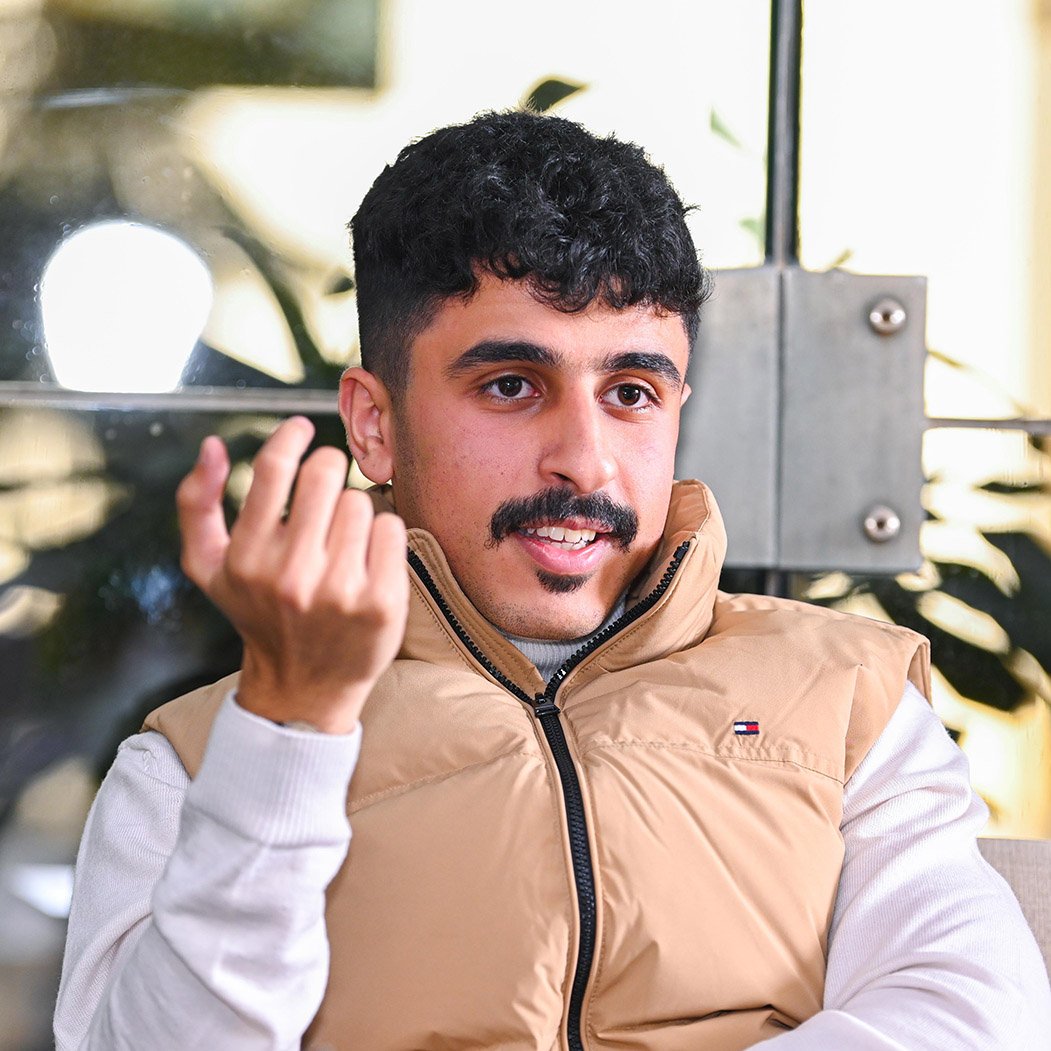
"Faris Alshahrany is a KFUPM Computer Science student and researcher specializing in federated learning (privacy-focused AI). With a background of living in Germany and Spain, he has built a profile defined by international adaptability and logical problem-solving."
Faris Alshahrany
computer science
Faris Alshahrany chose computer science at KFUPM not because of early exposure to the field, but because it aligned with his strength in logic and mathematics. Among the majors available to him, computer science stood out as the one most reliant on structured thinking. For him, coding was less about syntax and more about reasoning through problems step by step.
That preference for reasoning later guided him toward research. During the summer, Faris traveled to the UK through KFUPM’s Young Scholar Fellowship program to work on federated learning, a subfield of artificial intelligence concerned with data privacy. The problem he tackled was familiar to anyone concerned with how much personal information companies collect. Machine learning systems often rely on emails, passwords, and behavioral data to train models for targeted advertising, leaving users exposed if those datasets are breached.
Faris’s work focused on a different approach. Instead of sending raw data to central servers, he helped develop methods that train models locally on users’ own devices. Only processed updates are shared, keeping sensitive information where it belongs. The research resulted in a paper published at the University of Glasgow, followed by a conference presentation in Dubai on January 18, 2026. Faris plans to continue building on this work, refining techniques that respond to growing concerns about digital security.
The technical progress was only part of the experience. Living and working abroad strengthened his confidence in ways he did not anticipate. Collaborating with researchers from different backgrounds, navigating unfamiliar academic settings, and forming new connections pushed him beyond the quiet self-assurance he had relied on before. He returned more comfortable initiating conversations, exchanging ideas, and maintaining professional relationships across borders.
That confidence had already been tested and strengthened earlier in his academic journey, during a semester-long exchange at Arizona State University (ASU). The placement was selected specifically for his software and computer science background, and the transition proved smoother than expected. Compared to KFUPM, the academic workload felt lighter, which allowed him to balance coursework with sports, student clubs, and travel. This experience reinforced his belief that he could perform well outside his home institution and adapt to different expectations without losing focus.
His comfort with movement and change began early, however. Faris spent nine years abroad as a child, half in Germany during primary school and half in Spain during high school, where he learned Spanish and played for Real Madrid’s youth team. While his German faded with time, his Spanish remains strong. Those years taught him to adapt quickly to new systems and cultures.
Back in Dhahran, Faris gained a renewed appreciation for KFUPM’s campus culture. After three and a half years, he rarely walks across campus without seeing at least ten familiar faces. Friendships form quickly, often beginning with brief classroom exchanges that grow into lasting bonds. “I feel like every Saudi is my brother,” he remarked. Explaining that sentiment, Faris described how KFUPM students always help one another readily, creating an environment that feels closer to a brotherhood than a competition.
Faculty relationships reinforce that sense of trust. From his experience, professors at KFUPM are accessible, often sharing personal phone numbers and WhatsApp contacts rather than limiting communication to email. Faris recalls how faculty members checked in on him even after long absences during his exchange programs. Academic advising follows the same philosophy. Every student is assigned an advisor, but peer networks on Telegram and WhatsApp handle most day-to-day questions. Advisors typically step in only when challenges become serious. In Faris’s case, one professor even agreed to supervise research in an unfamiliar area, relying on trust rather than constant monitoring.
Outside the classroom, table tennis has been a constant for him. Faris placed third in singles during his freshman year in 2023 and seventh in doubles the following year. Competition is intense, with many players drawn from the Saudi national team. At ASU, he had also joined a table tennis team, winning a California tournament and qualifying for further play. He now tries to preserve the balance he developed abroad, starting some mornings with 6 a.m. runs around campus.
Entrepreneurship adds another layer to his KFUPM experience. Faris co-founded a startup with fellow students from other majors to offer affordable healthy meal planning for recent graduates. The team includes two software developers, a marketing specialist, and a main founder. Development will continue alongside his studies as he prepares for graduation and internship applications.
However, while his closest friends remain Saudi, Faris loves to see new international students on the campus. His advice to them is to prepare for the adjustment… to Saudi culture, to Arabic, and to unfamiliar routines. Homesickness is common at first. Still, he believes the challenge pays off in the end. So, he encourages new international students to take calculated risks, noting that progress usually follows those willing to step beyond what feels safe.
Looking ahead, he sees two paths: consulting or software development, both alongside his upcoming startup. He plans to keep the startup running while holding a traditional role, aware that entrepreneurship offers no guarantees. For Faris, stability and curiosity are not opposing goals; they are parts of the same equation he has been solving since his first days at KFUPM.
You May Also Like View All
- Choosing the Challenging Path as a Student Abdulrahman Aldaej Mechanical Engineering
- When Asking “Why” Opens New Paths Areej Alsadun Computer Engineering
- The Kingdom's Transformation Leads Chinese Student to ... Gouchen Zhao Electrical Engineering