Jun 16, 2026
A Student Research Innovation in Energy Storage Systems
A battery capable of charging itself using oxygen from the surrounding environment. Hybrid supercapacitors developed using activated carbon derived from basil. All of which were made possible through research that delved into the use of construction waste materials and, ultimately, achieved stronger performance than many conventional alternatives.
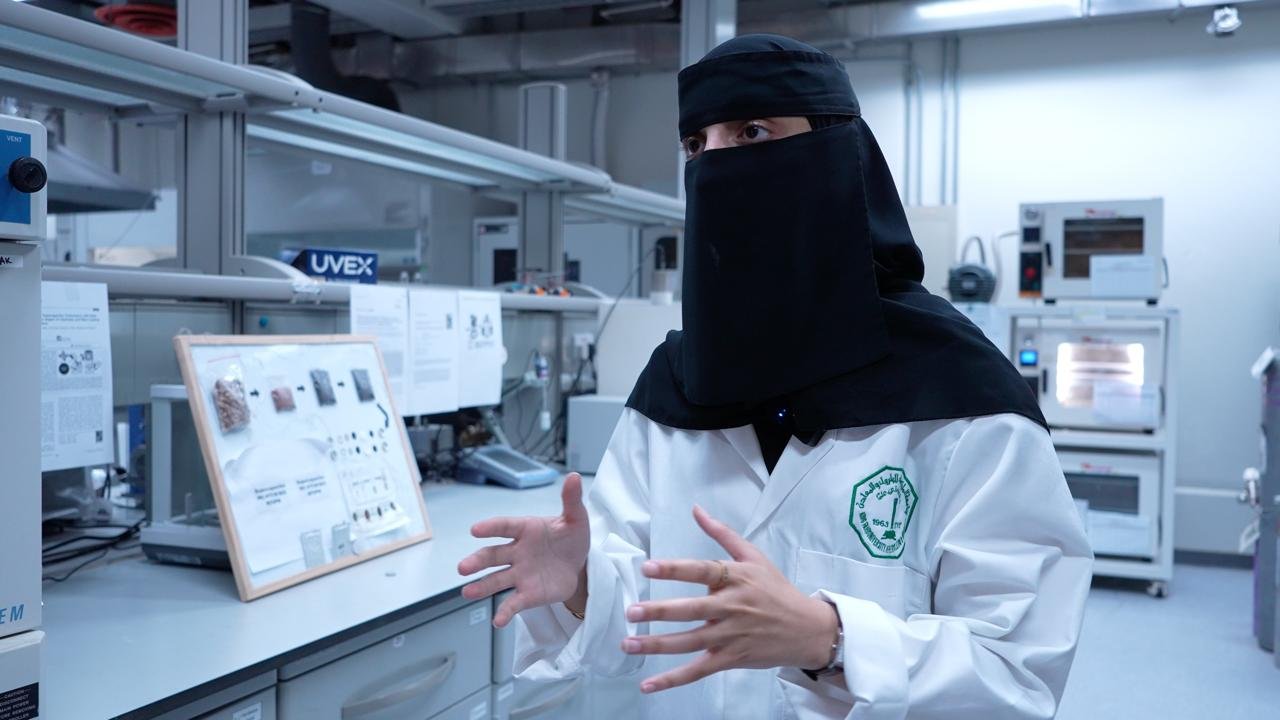
These projects formed part of a broader scientific journey pursued by Haneen Mohammed Alhassan, a Mechanical Engineering freshmen student at KFUPM, whose work in energy storage technologies later earned international recognition through the International Science and Engineering Fair (ISEF), led to a published scientific paper, and resulted in a patent submission.
Haneen’s award-winning project focused on developing a chemically self-charging battery that relies on oxidation-reduction reactions using oxygen from the surrounding environment. In simple terms, it was a battery capable of recharging itself from air without requiring an external power source.
The project later earned her fourth place at ISEF, one of the world’s largest pre-college scientific competitions. What made the research especially compelling was its sustainability-focused approach. Part of the project explored the use of construction waste materials within the battery system, where recycled materials unexpectedly delivered stronger performance than many traditional alternatives.
The work was developed through research opportunities and mentorship provided at KFUPM, particularly within the university’s Interdisciplinary Research Center for Hydrogen Technologies and Carbon Management (IRC-HTCM). Through the center’s labs, researchers, and programs, Haneen deepened her understanding of energy storage systems while continuing to refine ideas that had first started taking shape years earlier.
Before working on self-charging batteries, Haneen had already explored hybrid supercapacitors through research involving activated carbon derived from basil.
“We chose basil because it is widely available in the Kingdom,” she explains. “At the same time, it can provide a very high surface area, which improves the performance of hybrid supercapacitors.”
This may have earned Haneen a Gold Medal at ITEX, the International Innovation and Technology Exhibition, but for her, the experience also introduced her to the type of research environment she had long been searching for.
Her first attempt at developing the concept for Ibdaa 2023 did not progress beyond the central exhibitions, and the disappointment tested her resolve. But instead of abandoning the idea, Haneen refined the project alongside researchers at KFUPM’s Hydrogen Center, where she had met Dr. Zain Yamani, who helped guide her toward the right research environment, and Dr. Md. Abdul Aziz who mentored her development and helped strengthen her researching skills.
“One of the reasons I approached KFUPM was because many students who excelled in scientific competitions had started their journeys there,” she says. “Many universities do not allow high school students into their labs, but KFUPM’s doors were always wide open.”
After ITEX, Haneen joined KFUPM’s Summer Research Program to deepen her understanding of batteries and supercapacitors. At the same time, she found herself returning to the original idea that had first captured her attention: a battery capable of charging itself using oxygen from the surrounding environment.
Haneen’s research highlights the growing importance of sustainable energy storage technologies in a world increasingly reliant on renewable energy. By exploring self-charging battery systems and alternative materials derived from plants and construction waste, her work contributes to ongoing efforts to develop cleaner, lower-cost, and more sustainable energy solutions.
“There is no routine in research,” she says. “You work on something without knowing how it will end, or where it will lead you. Every stage makes you curious about what comes next.”
Her achievements at ISEF later qualified her for KFUPM’s Olympiad admission track, which offers high-achieving students in international scientific competitions direct admission to their chosen majors without requiring standard aptitude and achievement test scores.
For Haneen, however, the most meaningful part of the journey remains the time spent inside laboratories; experimenting, asking questions, and working alongside researchers in an environment that actively supports young scientific talent.
Today, she hopes to continue exploring energy storage technologies and expand into new research areas, building on a journey that began with a simple curiosity about how science can solve everyday challenges.